Showing posts with label nutrition.html. Show all posts

Monday, July 8, 2013

What the French (and Mom) Know About Maintaining Your Ideal Weight


For many of us West of the Atlantic, this past weekend (the long Independence Day holiday) was likely an exercise in extremes. With BBQs, picnics, parties and vacations rampant, it was likely marked by either extreme indulgence, or extreme self-restraint. I admittedly fell into the indulgence camp. I had the opportunity to spend the weekend at a country house in a small Connecticut town, where the biggest attractions are natural - lush, green, hilly surroundings for hiking/running/biking, and a lake for swimming/diving. Our intentions were good - we cooked every meal from scratch, enjoyed them as a family of friends and chose local, fresh ingredients wherever possible. Think wild caught seafood, quality cuts of beef from the local butcher (Mike), organic produce, etc. So why did we still end up with a grocery bill that 'nearly broke the town record' according to the butcher and store owner? And why did we have to cook and consume enough fresh cooked meals to feed 4 over a week - in 3.5 days? Because we're Manhattanites that have taken the 'go big or go home' a bit too seriously, that's why.

But seriously - we had an amazing time (and swam/hiked/dove/laughed off everything we ate) - so I can just chalk it up to a few days of enjoying some rather simple pleasures in the company of good friends. But I can't help but observe - the French (and Spaniards, and Italians for that matter) are notorious for living the good life and enjoying these familiar feasts much of the time - not exclusively on long holiday weekends. How come the word 'detox' is rarely - if ever - uttered by them after a long weekend?


I think it boils down to the culture of mindful eating. The French (and their neighbors) generally respect their meals. They sit down to eat. They chew their food, sip their wine and can linger over a dish for a good hour. Meals are celebrated - the details and nuances of texture, color, flavor and aroma are enjoyed slowly - so that each bite lasts. Conversation unfolds during the meal - and most diners aren't talking through a mouthful of food. They put their fork down and talk in between bites. In short - lunch (or dinner) is not inhaled in 5 or 10 minutes. And after 25 minutes over the same small dish they started with - they might even realize they're satisfied (head's up: it takes the brain 20 minutes to realize you're full). Which is in contrast to the second helping many of us likely have after 25 minutes over a given long weekend.

So, to surmise, I'm going back to the basics, and to what Mom always told me (but I needed an expert, or the French, to remind me). All the good-for-you fresh food choices in the world won't make up for the 300+ extra calories (and I'm being kind) you were too full to need, anyways. So sit down, slow your eating down, chew your food slowly and take at least 20 minutes over your dish. Enjoy that glass of wine and the conversation - in between bites and with a mouth devoid of food). And you may not need to 'detox' after a long weekend again.

P.S. In case you're detoxing today - try this for a few meals this week. It doesn't even need a recipe. Scramble the eggs, add chopped (organic) green onions and enjoy. Slowly. :)

- Paloma


Monday, June 24, 2013

Fresh Summer Dining (and Imbibing): Meal Pairing Ideas

Summer is to fresh, light meals what winter is to comfort food. While it instinctively FEELS easier to eat fresh, light and quick-to-prepare meals in the summer - it's also easier to forget that your own kitchen and market-bought produce are part of your routine when you're spending a lot more time out soaking up summer. Alas, guacamole, chips, and two (or three) margaritas aren't exactly what 'fresh seasonal dining' refers to.

While I wouldn't dare suggest you shouldn't enjoy that occasionally (I'll take my guac with a caipirinha, please), I do want to give you some ideas for what you can prepare yourself this summer - in advance or on the spot - to treat yourself and loved ones to the best of the season (without gaining a pound). And in the spirit of kicking back, it will even go well with whatever you're imbibing on:

1) To pair with a mimosa at brunch:


Buy: 
  • 1/2 cup quick organic oats
  • 1 cup unsweetened almond milk
    • Do you know that this almond milk has 50% more calcium than cow's milk? It's also a crazy strong source of Vitamins E and B12, which you need for skin health and for higher energy level, among numerous other benefits
  • 1 tablespoon chia seeds
    • These kids are loaded with magnesium, potassium, iron, calcium and fatty acids for slower digestion - and all you need is 1 tbsp 
  • 2 tablespoons Just Great Stuff organic peanut butter powder
    • I add this for texture, additional protein and more flavor - but it's entirely optional
  • Organic blueberries
    • For sweetness, texture - optional
  • 1 tablespoon acacia honey
Prepare: 
  • Add all the ingredients to a small pan and bring to a boil
  • Pour into a bowl, top with a tablespoon of honey and blueberries, to taste
Enjoy:
  • All this for under 300 calories, a ton of protein from the almond milk and powdered peanut butter, Omega-3 from the chia seeds, half your Vitamin E and B12 daily requirement, several other nutritional benefits - and a delicious, satisfying breakie. 

2) To pair with a good glass of AlbariƱo (or any good glass of wine) at lunch or dinner:


Buy: 

  • Dry lentils of any variety (1 cup dry for 2-3 servings)
    • I have yet to see a definitive point of view or answer on whether sprouted lentils vs. regular cooked lentils are nutritionally superior. So keep in mind that they're both light in calories but nutritionally dense per cup of cooked lentils (great sources of iron and protein), and go with whatever texture you prefer.
  • Olive Oil (1.5 tablespoons)
  • Fresh cilantro
  • Salt, pepper, lemon to taste
Prepare: 
  • Bring a pot of water to boil, cook the beans for about 5-8 minutes, depending on how dense vs. soft you prefer the texture
  • Rinse
  • Toss with olive oil and chopped cilantro
  • Season with salt, pepper, lemon juice to taste
Enjoy:
  • Serve it as an accompaniment to salmon, over greens or by itself. And savor with wine.

3) To pair with a cold margarita or caipirinha:


Buy:

  • 85% (or higher) lean, grass-fed ground beef (1 lb. for 2-3 servings)
  • Organic scallions, or green onions (4 stalks)
  • Bottled salsa verde (never canned)
    • If you want to make this yourself, hats off! I admit I served mine from a Stonewall Kitchen bottle - of natural ingredients only, not a preservative in sight. If I were having you over for dinner, I would never serve you anything from a can. But if you must, read the label and choose wisely.
  • Fresh cilantro ('tis the season)

Prepare:

  • Chop 4 stalks of scallions
  • Cook the ground beef in a heated pan, breaking it up with a wooden spatula
    • You won't need oil - the beef will cook in its own fat as its released, which I like to drain out as I go. But this is up to you.
  • Cook until it's of your desired texture and taste - I like mine relatively well done
  • Before it's fully cooked, add the chopped scallions and a few tablespoons of salsa verde
  • Top with cilantro
Enjoy!
  • I eat to avoid inflammation and acidity, so I only pair beef with greens - never rice, bread or starches. But if you have no digestive issues to contend with, feel free to serve on top of rice, in a soft taco shell, or alongside greens, as I do. 
  • The mild heat of the salsa verde will pair amazingly with the sweet tartness of the margarita (or cocktail with similar flavor profile)

4) And, for dessert... (with a good glass of port, or whatever you'd like, really)


Buy (per serving):
  • 1/4 cup unsweetened almond milk (same one I mentioned above, for the same reasons)
  • 1/4 cup vanilla coconut milk (high in Vitamins B12 and D, which you need for energy)
  • 1.5 tablespoons chia seeds (for the same reasons I mentioned above: protein, Omega-3 and slower digestion = more energy, babe)
  • 1 tablespoon unsweetened, organic grated coconut (for texture)
  • 1 tablespoon honey, to taste
Prepare:
  • Add all the ingredients (except the grated coconut) to a cup/small bowl and mix
  • Top with the grated coconut
  • Cover and refrigerate overnight
Enjoy:
  • You soak this overnight so that the chia seeds expand; they will be tasteless but provide a tapioca-like texture. And by combining the chia seed with a protein source like almond milk facilitates easier absorption by your body
  • This is nutrition disguised as dessert, with just a bit of sweetness from the honey and the natural sweetness of the coconut milk
  • A bit of sugar - but a lot of slow-burn energy
  • Have it for dessert, as a snack, or with breakfast
Until next time,
- Paloma


Thursday, June 20, 2013

Weekend Smug Satisfaction: Conquering Fava Beans


My intention in starting this blog was to focus on fresh, nutritious and easy recipes that ultimately satiate your taste for good food, nourish your body - but take minimal time and effort to prepare. Which makes fresh fava beans a bit of an anomaly. While they're still in season and incredibly delicious, I have to caution you that these will take about 40 minutes to prepare and cook. Cook these on the weekend while sipping a glass of wine and you'll feel grounded and accomplished. Cook these on a weeknight while you're hungry and you may feel more frustrated and hungry than smugly satisfied.

So, onwards. Why fresh fava beans? Nutritional benefits, according to Livestrong (hey, love him or hate him - the website is still a fantastic source of information):
A one cup serving of cooked fava beans provides 187 calories, 33 g of carbohydrates, 13 g of protein, and 1 g of fat. Fava beans are an excellent source of fiber with 9 g per one cup serving. Additionally, fava beans offer the benefit of 177 mcg of folate, or 44 percent of the daily value. Copper, manganese, and phosphorus are also key nutrients present in fava beans. Canned fava beans have 500 mg of sodium in one cup, while the fresh variety has only 18 mg.
Now, here's what you do with them:
  1. Buy: About 2 lbs. of fresh beans. 2lbs. will yield just over a cup of beans, in the end, and you'll lose all of the beans' shells.
  2. Shelling Part One: Bean by bean, you'll tear or cut off the tip, pull on the stalk or 'string' on the horizontal side of the bean, open the shell and just keep the 4-5 beans inside each shell. They will look like wax-coated beans. Depending on how many you buy, this is where you'll spend most of your time.
  3. Cook: Boil them or steam them. I boiled mine between 5 - 10 minutes.
  4. Cool: Remove the now shriveled-looking beans from the hot pot, and run under cold water to cool off. 
  5. Shelling Part Two: Once cooled, you're going to take each bean and apply manual pressure in order to pop the smaller bean out of the waxy, shriveled shell. You'll be left with shiny, bright green beans that look like the photo above.
  6. Dress Them Up: This is the easy part. Add some olive oil, salt (or truffle salt, in my obsessed manner), ground pepper and cilantro to taste. If you're among those that dislike cilantro, try basil, parsley, or another fresh herb to your liking. 
  7. Chill and Enjoy! A perfect light summer salad served cold, by itself, as an accompaniment to grilled fish, or tossed with greens.
  8. Extra points: Try this with liver and chianti. Ja!
Until next time,
- P

Sunday, May 19, 2013

Get 'Em Before They're Gone: Greenmarket Ramps Sauteed with Oyster Mushrooms


I hit Union Square's Greenmarket yesterday and bagged some amazing ingredients for this week's seasonal Spring dishes, based on completely different ingredients than what have become my habit. Hey, habits are fantastic - they're what keep us disciplined, are stronger than willpower and help us make consistent progress toward our goals - but they can breed boredom. I left my green market run with 9 ingredients (photo above) for at the very least 6 new dishes, each using 5 or fewer ingredients. I'm going to break up the recipes into individual posts over the next couple of weeks, but will start with two ingredients: ramps and oyster mushrooms.


Ramps look and cook like scallions, but taste like creamy garlic. They can be chopped and sauteed to flavor other dishes, and the long leaf can even be eaten whole. Nutritionally, they deliver 30% of your daily requirement of Vitamin A (for healthy skin, bones, soft tissues and vision) and 20% of your required Vitamin C intake (for stronger immunity). They're also a great source of folic acid (needed for cell regeneration and to the reduce the risk of heart disease and colon cancer) and selenium (an antioxidant that helps repair damaged cells and keeps your thyroid healthy).


Oyster mushrooms have a rich history in Chinese medicine. They are respected for their antioxidant and antibacterial properties, and are understood to have a detoxifying effect in your system. Not to mention that they taste creamy - I'm willing to set aside the portobello mushroom and claim these as my Favorite Funghi thus far.

So they're great for you, check. Now here's what I did with them as one course of a highly seasonal Spring dinner: behold, sauteed oyster mushrooms with ramps:


  • Prep: Wash 6 ramps (if you're cooking for two) and 2-3 large oyster mushrooms. On the ramps, cut off the tiny edge that appears to have 'hair' at the end. Then chop the entire ramp, including the leaf - it's edible, tastes and cooks great. For the oyster mushrooms, simply pull off the bulbs and set aside. Toss any 'stems' at the heart of the mushroom that may feel too hard for your taste.
  • Cook: Drizzle about 1 tablespoon olive oil on a good saucepan. Once, heated, add your chopped ramps and oyster mushroom bulbs. Stir and cook until the mushrooms shrink and are visibly cooked. They might look a bit translucent.
  • Serve: Add salt and pepper to taste (I used Himalayan pink salt and freshly ground black peppercorn). Enjoy with a good glass of rose on a Spring night (or afternoon)
Told you it'd be easy. If you try this, let me know what you think! More to come,

- Paloma

Sunday, May 12, 2013

Preview: Sunday Night Dinner

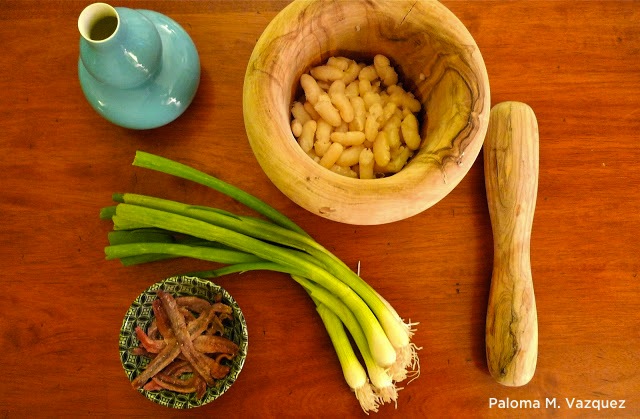
So, I started out making my truffled cannellini mash for the week, but decided to add a couple of different flavors and texture - some crispiness and savoriness with green onions, and some saltiness with anchovies. What's not photographed is the truffle oil and salt, but this was an experiment in photographing fresh ingredients, as much as it was cooking. Rookie mistake? Yes. But you have to start somewhere.


Friday, May 10, 2013

Recalibration, Day 2.5 and Disaster Prevention: What to Keep On Hand for When You're Too Tired To Cook

* Image attribution to New York Times

I'll keep this post short, and without a recipe per se - but with some creative, easy go-to recommendations.

Some of you may know that I'm challenging myself with a two-week recalibration to shake my sugar addiction (beyond the obvious, see this video to understand why I believe this is important), and to generally hit the reset button on my body and digestive system. I generally make very healthy food choices, buy and consume a lot of organic produce, choose pastured beef - but good Lord, do I love my sweets. 2+ tablespoons of honey with my morning oatmeal. Honey and lemon with green tea (twice a day). A little piece of chocolate after lunch or dinner - you get the picture. It may be natural, but it sure adds up (did you think I was done with the honey after breakfast? Nay.) Once you have some of the good stuff, your taste buds generally want MORE.

So, back to recalibration. Darya Rose's approach is very simple and boils down to eliminating 4 key foods:
  1. No sugar 
  2. No wheat
  3. No dairy
  4. No alcohol
So, I'm 2.5 days in, and I can already notice a clear change in my mood and energy levels throughout the day. No highs and lows of blood-sugar (and energy level) before and after meals. No bloating.  A clearer mind. And I'm challenging myself with slowing down and recognizing what's driving any desires to snack - is it escapism from a piece of work I'm trying to crack, boredom, frustration - or truly hunger? 

I'm definitely 'all in' on this. I feel good. I'm motivated to lose my rabid sweet tooth, and to gain full control and awareness over my food choices. Call me a masochist, but I enjoy a challenge that forces me to understand what's beneath any sense of discomfort.

But last night, after a later evening at the office and catching up with some friends, I didn't get home until after 9pm, feeling tired and HUNGRY - and honestly, not motivated to wait 20 minutes to cook some quinoa or farro. I was also out of fresh greens (and in need of a market run immediately). I know this is a question often asked by a lot of us - what do you choose that is easy and healthy when you just don't feel like cooking? I need this go-to list, as well - so here's what I netted out at:
  • Eggs (organic): they take 5 minutes to scramble and cook (I enjoy a good breakfast for dinner)
  • Arugula, kale or baby spinach for a quick salad (just add olive oil, salt, pepper and toss)
  • Baby tomatoes: Toss with olive oil, by themselves or with other greens. You can lose count of these kids and they won't make a dent in your waistline - but they will fill you up
  • Avocado: Take half, add salt and eat by itself or on greens. Alternatively, mix with bananas, lemon juice and fresh pineapple chunks (if you have them). Delicious salad with protein, essential fatty acids, vitamin C and natural sweetness.
  • Yellow squash: 5 minutes to shred with a good peeler and saute in 5 minutes. And behold... squash 'pasta'!
  • Bananas: Instant potassium and satiation when you'd otherwise grab a cookie. Also, toss with avocado for a surprisingly good salad.
  • Gluten free oats (devoid of any traces of wheat): 5 minutes to home cooked oatmeal. Again with the breakfast for dinner
  • Almond butter (more nutritious than peanut butter): Make sure you choose one that is natural, has 2-3 ingredients max. Store it bottom up so that the oil rises to the bottom of the jar. Add it to almond milk and a banana for a nutritious, tasty and fast smoothie.
I know I'm but touching the surface here - there's so much you can keep on hand to maintain your healthy food choices, even when you just...don't...feel...like cooking. What other ideas do you have? I'd love to hear and learn from your creative go-tos.

P.S. So much for a short post. Have a great weekend!

- Paloma

Tuesday, May 7, 2013

Why (Good) Habits Beat Willpower: The Habits of a 'Foodist'


I've had at least a couple of conversations recently about the mindfulness (or rather, the risks of the mindlessness) of eating. It seems that when the daily routines and stresses of our lives - and the need to be distracted from and escape them - accumulate and frustrate us, many of us tend to fall into a pattern of mindless eating. It may seem negligible - an afternoon cookie treat never killed anyone. But too often, when stress and a sense of mental or emotional discomfort persists beyond a few days, mindless eating becomes a pattern. You may develop the craving for something sweet every afternoon around 3pm. Fruit might be replaced by a cookie. And too many late nights at work might elevate from a fling to mercurial relationship in the always-receptive web of Seamless (or takeout) - all accompanied by 3 glasses of Malbec. Eat your feelings, much?

Some of you may have heard me rave about Summertomato before, as a smart resource for practical food + nutrition information, and a no-b.s. whole foods philosophy. So it felt like a moment of serendipity when I stumbled on Darya Rose's post yesterday, Focus More On Your Mind and Less On Your Diet If You're Serious About Losing Weight. While I encourage you to read the piece and take from it what you will, I was left mulling over three key ideas:

  1. Stress doesn't always have to lead to mindless eating: Mindless eating is rarely about hunger, and more often about the need to satiate a higher-order need. If you're reaching for the delivery menu and a keypad stroke away from eating your feelings, what need are you looking to fill? 
  2. Mindless eating (stress) is stronger than willpower: I understand that answering the aforementioned question (what emotion am I eating?) requires some self-reflection that will most often require some time. But the awareness of that question may make the difference between fried rice with orange chicken and, say - a sushi roll and a seaweed salad.
  3. But good habits trump all:  Develop beneficial habits that produce a compelling reward (personally, compliments or fitting into an old high-school dress work for me. Vanity, thy name is Paloma...), and you'll stick to them. Find healthy foods you enjoy eating, find a workout you thoroughly enjoy and make them more readily available to you. Pack your lunch. Find a home workout for when you can't get to the gym. Start by identifying those desired actions (and eventual habits) that feel good for you to do. Give yourself - at the very least - 2 weeks for consistent actions to become a habit.
On that note, I realize 'healthy' food has become something like the word 'engagement' in my industry (digital marketing): overused, lacking definition and unnecessarily meaningless. What is 'healthy' when packaged food labels scream 'low-GI', 'natural', 'organic' or what be it - and, despite eating your weight's worth in them - you're still not losing weight (hence the problem)? Enter the whole foods philosophy of Darya Rose (and encouraged by others).

Darya recently published Foodist: Using Real Food and Real Science to Lose Weight Without Trying. At the expense of oversimplifying, it's a practical guide to identifying whole, real foods (read: most of them won't come with an ingredients label) that you LOVE, and building a practical, sustainable food-style around them. While cooking your own food is a large part of maintaining good habits (and why I started this blog), she recognizes you WILL and should enjoy restaurants, as well - and will identify how you can navigate restaurant selections to your benefit. Lastly, it's all grounded in science - she's a neuroscientist.

This will be my nightly reading for the next few days. In the spirit of sharing what's on my radar and guiding my decisions, thought I'd make you aware of it, as well.

- P


Sunday, May 5, 2013

Hit the Sauce! Home-Made Basil Pesto


After catching a Spring cold (and allergies), I've very reluctantly spent more of the weekend indoors than I'd have liked. Despite the perfect 50's - 60's temperatures, endless sun and perfect biking conditions - congestion, going through multiple tissues in a half hour, eyes welling up, etc. - made it too uncomfortable to be outdoors for long. I know...DEAD SEXY. But rather than sulk more than I already have, I decided to up my own ante as a home chef by making my own sauce from scratch. I wanted something fresh, versatile, easy on ingredients (less than 5) and quick to prepare. Hands down, I went for basil pesto.

I'll start by saying that - in addition to being delicious and one of the most aromatic herbs that can fill your kitchen - the humble basil leaf is rather nutritious. And for someone that suffers from highly irregular PVCs (they're under control now), I was surprised to learn that basil is actually particularly good for cardiovascular health. According to Livestrong (say what you will about Armstrong, but the site is still extremely informative):

  • Basil is high in several vitamins and minerals related to cardiovascular health, including the antioxidant vitamin A, which prevents free radicals from oxidizing cholesterol and causing it to build up in the blood vessels; and the mineral magnesium, which causes the muscles and blood vessels to relax, thereby helping improve blood flow and reduce risk of irregular heartbeat or heart spasms. Dried and fresh basil are both high in folate and vitamin K and contain trace amounts of vitamin E and the rest of the B vitamins. Basil also has vitamin C, calcium, potassium, phosphorus, iron and trace amounts of other essential minerals.
  • Additionally, basil contains flavonoids like vicenin and orientin with antioxidant properties, as demonstrated in a 2001 study reported in "Mutation Research." The study showed that these two compounds, extracted from Indian holy basil, protect human lymphocytes from exposure to low and non-toxic levels of radiation. Basil also has volatile oils with anti-inflammatory and antibacterial properties, as demonstrated in a 2010 "Pharmaceutical Biology" study on sweet basil. The researchers found that its essential oils have antibacterial effects on a number of pathogens, including staphylococcus.
So it's delicious, can aid cardiovascular (and overall) health, fills a kitchen with an incomparably fresh, natural scent, and is versatile (use to top cannellini beans on in my truffled mash, pasta, crostini or with vegetables). And it was crazy easy to make. Here's how:
  • Buy: A generous bunch of fresh basil (preferably organic), good olive oil, pine nuts and sea salt. 
  • Prep: In a food processor/chopper, add basil and about 2 tablespoons pine nuts and chop. If the container is too small to hold all your basil leaves at once, just chop as much as you can and then add more basil leaves gradually. Once all your basil and the 2-3 tablespoons of pine nuts are chopped, slowly add a bit of olive oil (a drizzle at a time) until it reaches your desired consistency. Personally, I like mine a bit chunky, with a much higher ratio of basil and pine nuts to olive oil. But the consistency is your call.
  • Eat: Enjoy as a sauce over pasta, spread it on bread, or savor your creation from a small spoon. Refrigerate the rest and enjoy throughout the week.
Despite my nasty congestion, I thoroughly enjoyed the scent of basil throughout my kitchen, and the smug satisfaction of knowing I made this classic Italian sauce myself - and that it tasted amazing. I might now be ready to cook for my Italian friends. Dolce vita indeed.

- Paloma


Saturday, April 27, 2013

In Season: The Elusive (Baby) Artichoke


One oft-lauded theory I try to practice is eating produce that is in-season (and preferably, local). Sounds simple enough, but figuring out exactly what's in season and what isn't can be tricky when so much produce at our markets is imported (or worse - genetically modified to grow year-round). Stumbling onto this infographic was a God-send - visual, clear, simple. I've saved the images to my iPhone for easy reference at the store; might help you, too.

Which brings me to a rather polarizing Spring vegetable: artichokes! I thought I was relatively fearless in the kitchen, but seriously - every time I see these thorny little kids at the market, I turn my gaze downwards and stroll past them, hoping they won't recognize my shame. I know they're delicious when cooked a la Romana, amazing steamed and drizzled with olive oil, and loaded with nutrition. According to Organic Authority, they're a 'super source' of fiber, Vitamin C, magnesium, iron and potassium, and known for their antioxidants lutein and zeaxanthin, which support eye health. They're considered detoxifying (a liver-cleanser), a diuretic, a digestive aid and lower cholesterol. So what's not to love and OD on while they're in season? The fact that they're intimidating as hell to prepare - at least to the novice (me).

So, I went for a 10-mile bike ride (it's a mind-blowing beautiful Spring day in Manhattan - 60s - so the whole city is in heat), and came home energized to do this. I bought baby artichokes (smaller, faster to cook, and you can eat the heart whole, unlike regular artichokes). I wanted them crispy vs. soggy, so I decided I'd experiment with an 'a la Romana' variation (read: not fried and quick to prepare). So here's what I did:

  1. Prepare: 1 large bowl with ice and the juice of half a lemon; toss in the used lemon slices
  2. Clean: Wash them. Then cut off the stem and the top layer of the baby artichokes, removing all the thorny ends and outer leaves. See this for detailed reference. While the recommendation was to remove any leaves with purple, I decided to keep some of them on because I actually enjoy the crispier, firm texture of the outside layers. Plus, I wanted protection from their becoming soggy. This was my choice (for better or worse), but you can chuck any leaves with purple.
  3. Protect (from browning): As I finished cleaning each choke, I'd quarter it and immediately add it to the bowl in step 1 
  4. Cook: Heated a great ceramic pan (medium heat) with 1 tbsp olive oil and finely chopped garlic. I used a couple of cloves, but this is entirely up to you. Shook the water out of the artichoke quarters, and tossed them onto the pan. Added more lemon juice and truffle salt gradually, lowered the heat a bit, and cooked them for about 10-15 minutes at lower heat. I like them a bit crispy, so that was sufficient for me.
And voila: the finished product is photographed.

The verdict: Very tasty (the olive oil, lemon and truffle salt complemented them perfectly). Crispy and chewy on the exterior (granted - I like them a bit burnt). Creamier as you get closer to the middle. And the intimidation factor is gone. I can cut and prepare baby artichokes. But this was only strike 1 - I'll continue experimenting with these until I land on the perfect degree of crispiness to honor the Romans' intention. Stay tuned for that one.

Have a great weekend!
- P

Friday, April 26, 2013

Picking out the real food from the junk at the supermarket

I'm a big fan of Darya Rose's blog, Summer Tomato. Straight-up, science-based advice on what to eat - and it boils down to REAL food. The kind that grows from the ground, grazes pasture or swims in the sea. The kind of food that lacks a barcode. I love this take on how to navigate the grocery store - keeping it real on how to pick real food. Word.